Featured Snippet: What is the Core Difference?
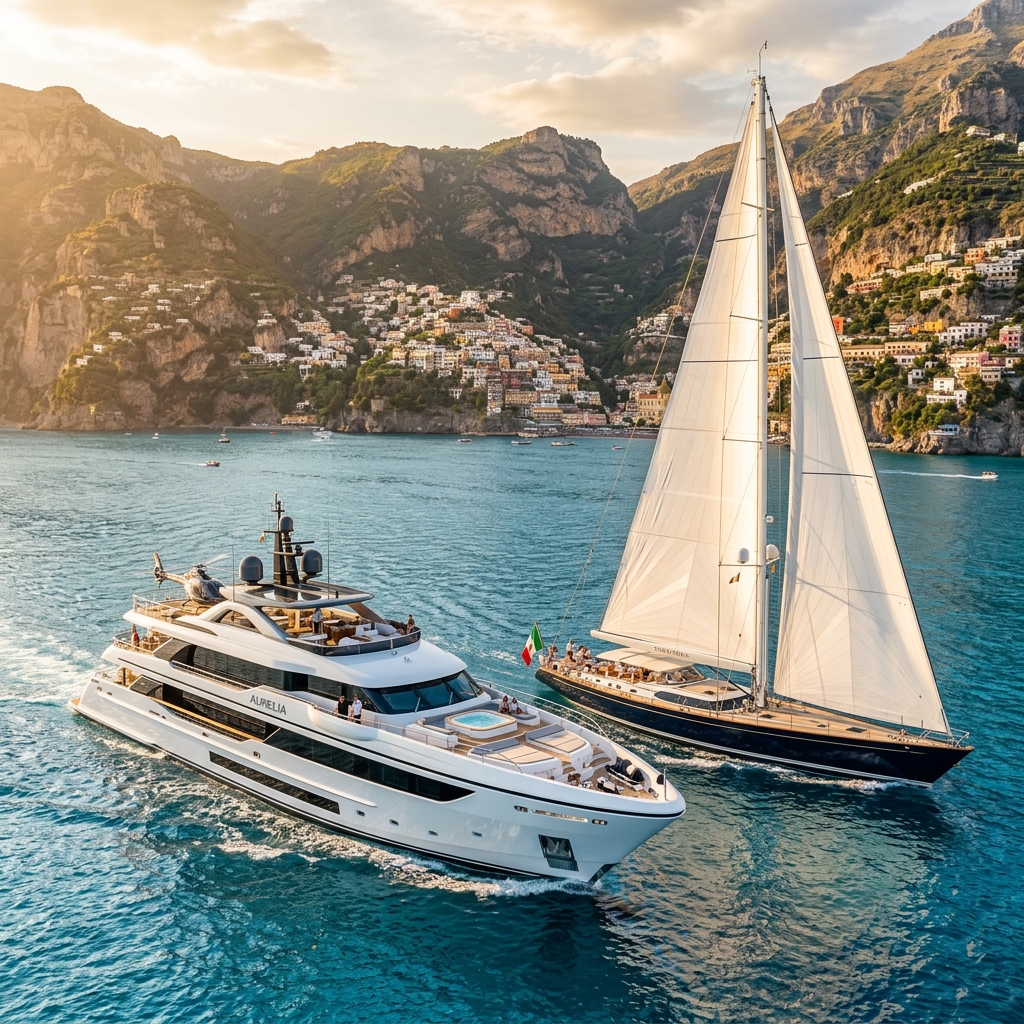
The primary difference in a motor yacht vs sailing yacht charter comes down to Volume and Speed vs. Experience and Elegance. A motor yacht acts as a massive floating hotel; it offers significantly more interior space, higher cruising speeds, and complete stability. A sailing yacht offers a thrilling, romantic, and eco-friendly connection to the sea. Motor yachts are generally more expensive due to the massive fuel costs associated with running twin diesel engines.
You are ready to book a superyacht for your upcoming Mediterranean or Caribbean vacation. The dates are set, the budget is approved, but you are faced with a fundamental choice that will dictate the entire rhythm of your trip: Do you want the sheer power and volume of a motor yacht, or the classic romance of a sailing yacht?
This is not merely an aesthetic choice. The choice between a motor superyacht and a sailing charter impacts everything from your itinerary speed to your total APA (Advance Provisioning Allowance) bill at the end of the week.
Let’s break down exactly what to expect from both vessel types so you can make the perfect choice for your guests.
Executive Briefing: Table of Contents
Compare Both Fleets
Our elite partners offer access to the world's most sought-after motor superyachts and classic sailing sloops.
Compare Live Motor & Sailing Charter Rates →1. Speed and Itinerary Flexibility
If your goal is to see as many destinations as possible within a 7-day charter, a motor yacht is the undisputed winner.
Motor Yachts: A modern motor yacht cruises comfortably at 15 to 20 knots. If you wake up in St. Tropez and decide you want to have dinner in Monaco, the captain simply throttles up, and you are there in a few hours. The itinerary is highly predictable and entirely under your control.
Sailing Yachts: Sailing yachts move at a slower, more deliberate pace (typically 10 to 12 knots under sail, depending on the wind). Furthermore, the itinerary is dictated by Mother Nature. If the wind is blowing forcefully from the north, sailing north will require constant "tacking," making the journey long and heavily angled. Sailing requires a more flexible mindset: the journey is the destination.
2. Interior Volume & Deck Space
When comparing two 150-foot yachts, the motor yacht will feel substantially larger inside.
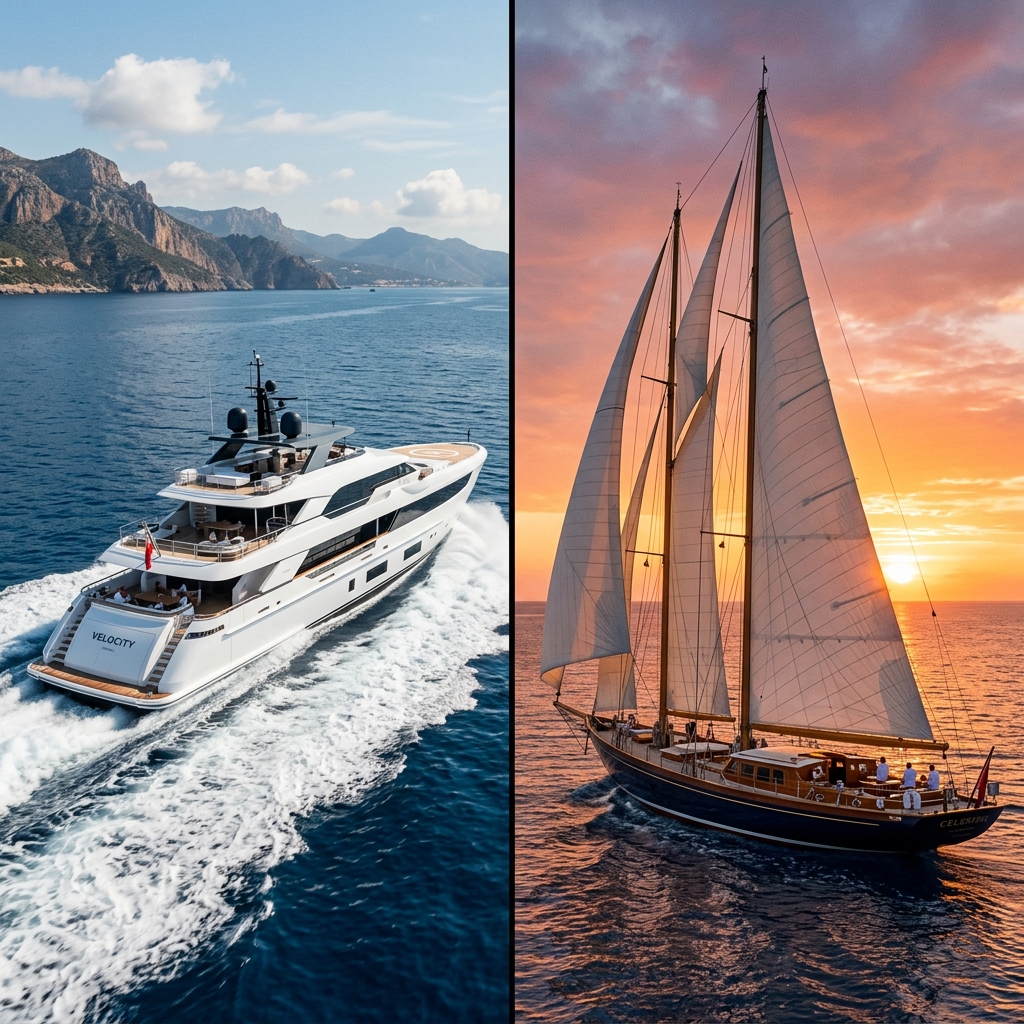
- Motor Yacht Volume: Motor yachts are built upwards. They often feature three to four distinct decks (Main deck, Bridge deck, Sundeck). This allows for massive master suites on the main deck, sprawling indoor dining rooms, and massive beach clubs at the stern for deploying jetskis and tenders.
- Sailing Yacht Volume: A sailing yacht must remain relatively low to the water to accommodate the massive mast and rigging. The interior space is generally located below the main deck. While exquisitely luxurious, the cabins are smaller, and you will not have the towering, multi-level sundecks found on motor yachts.
3. The Sensation: Thrill vs. Stability
The physical sensation aboard the vessel is drastically different.
The Sailing Thrill: When a sailing yacht catches the wind, it "heels" (leans) over. The engines are cut, and there is near silence aside from the rushing of the water. It is an incredibly romantic, thrilling sensation that connects you directly to the ocean.
The Motor Yacht Stability: Motor yachts are designed to stay as flat as possible. They are equipped with state-of-the-art "zero-speed stabilizers" (essentially underwater wings). Whether you are cruising at 15 knots or anchored in a bay, your martini glass will not slide across the table. For guests prone to seasickness, a stabilized motor yacht is vastly superior.
4. Cost Difference: The Impact of Fuel (APA)
When booking a superyacht, you pay the base charter fee plus the APA (Advance Provisioning Allowance).
A motor yacht requires you to pay for the massive amount of diesel fuel required to push thousands of tons of steel through the water at 20 knots. For a busy Mediterranean itinerary on a 150-foot motor yacht, your fuel bill alone can exceed $20,000 to $30,000 for the week. Because of this, the APA for a motor yacht is typically set at 30% to 35% of the base fee.
Because sailing yachts rely primarily on the wind, their fuel consumption is vastly lower. The APA for a sailing yacht is usually set at a much more manageable 20% to 25% of the base fee.
5. The Verdict: Which is Right For You?
Choose a Motor Yacht If: You have a large group, you want massive deck spaces for entertaining, you require absolute stability for guests prone to seasickness, and you want to pack multiple destinations into a tight itinerary.
Choose a Sailing Yacht If: You value romance, eco-friendly travel, and "old-money" elegance. You enjoy the journey as much as the destination, and you don't mind a slower, more deliberate pace through the islands.
Finalize Your Decision
Our brokers are standing by to help you compare specific motor yachts and sailing yachts side-by-side.
Speak with a Maritime Specialist →Charters Arranged Since 2019
Global Destinations
Dedicated Maritime Desk
Request Your Custom Yacht Charter Proposal
Compare motor and sailing options tailored to your destination & dates. Confidential & no obligation.
Elite Insights: Yacht Comparison FAQ
Is a motor yacht or a sailing yacht more expensive to charter?
Motor yachts are generally more expensive. They command higher base charter rates due to greater interior volume, and their APA (Advance Provisioning Allowance) is significantly higher because of the massive fuel consumption of twin diesel engines.
Which is better for families: a motor yacht or a sailing yacht?
Motor yachts (and especially power catamarans) are usually preferred for families with young children. They offer more interior space, flatter decks, less leaning (heeling) underway, and a wider array of motorized water toys like jetskis.
Do sailing yachts use their engines?
Yes. All modern luxury sailing yachts have engines. They use them to maneuver in and out of marinas, and to stick to a strict itinerary when the wind dies down. However, they rely primarily on wind power whenever possible.